
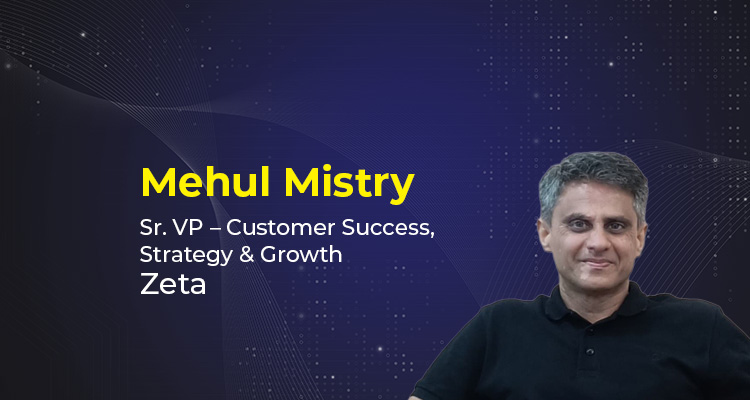
Zeta’s platform covers cards, loans, deposits, fraud, loyalty, and digital apps, all in one stack. How does Zeta keep that from becoming too complicated to manage and what differentiates its portfolio from others in the market?
Zeta’s stack is organized into three platforms with clearly bounded responsibilities, each purpose-built. Tachyon handles core banking and transaction processing for credit cards, debit cards, prepaid accounts, UPI issuing & acquiring, and digital credit. Cipher handle’s identity, access management, and security for consumer, enterprise and agentic applications. Neutrino handles omni-channel digital experience and engagement, with a unified intelligence layer built on its own knowledge ontology. All three are proprietary IP built from first principles.
Data flows natively across processing, compliance, rewards, and customer experience which makes the full-stack breadth operationally coherent. Underlying all this is Zeta’s private, portable, cloud-agnostic PaaS layer that centralizes common infrastructure concerns – multi-tenancy, logging, monitoring, tracing, and data and event streaming, across all banking and payments applications.
Differentiators of Zeta’s stack:
1. Unified Platform Architecture – Built as a single, integrated stack rather than assembled through acquisitions. Processing, compliance, fraud, rewards, and customer engagement operate on a common foundation, eliminating integration complexity and data silos.
2. Flexible Multi-Product Core – A polymorphic entity model enables credit cards, loans, prepaid, deposits, and emerging products to run on the same platform. New products are configured, not rebuilt.
3. Cloud-Native by Design – Built on API-first, event-driven microservices and deployable across public cloud environments with multi-tenancy, observability, and embedded identity controls. This enables rapid releases, resilience, and elastic scaling without legacy infrastructure constraints.
4. Deep Configurability – Product rules, pricing, fees, rewards, and policies can be changed without code. Granular configuration enables institution-level and customer-level personalization on a scale.
5. Proven Hyperscale Performance – Scale has been demonstrated in production and benchmark testing:
- 208M credit accounts are processed in 40 minutes
- 40M statements generated in 5 minutes
- 1M authenticated TPS
- 60M+ accounts and 75M+ payment instruments supported across live deployments
6. Compliance and Delivery at Scale – Compliance controls are embedded into the platform architecture, while a large specialist delivery organization ensures successful execution in regulated banking environments.
More than 70% of Zeta’s team works in technology. How does a company with this engineering-heavy stay connected to the real-world needs of banks and their customers?
At Zeta, our vision is to democratize banking, to help financial institutions expand the reach, utility, and influence of banking for their customers. That vision is what keeps an engineering-heavy organization grounded in solving real banking problems
While, more than 70% of Zeta’s workforce is in technology, our roadmap is shaped by banking expertise, operational experience, and client feedback and not engineering in isolation. We work closely with banks and issuers throughout implementation and ongoing operations, maintaining deep engagement with our clients at every stage, giving us direct insight into the challenges of running financial products at scale. That creates a continuous feedback loop between customer needs, operational realities, and product development.
Many of our leaders, product managers, and engineers come from banking, payments, and financial services backgrounds. We also invest in structured training to ensure teams understand the regulatory, risk, operational, and commercial dimensions of banking.
Our roadmap is informed by learnings across clients, markets, and regulatory environments. Rather than solving for one institution, we identify common patterns and translate them into platform capabilities that benefit the broader ecosystem.
Zeta is built cloud-native, but most banks still operate in hybrid or on-premises environments. How does Zeta handle that gap between its architecture and what financial institutions are actually ready to run?
Being cloud-native and supporting hybrid environments are not mutually exclusive. In fact, hybrid is the reality for most banks today.
The advantage of a cloud-native platform is not that a bank has to move everything to the cloud at once. It’s that the bank can modernise at its own pace. Zeta integrates with existing core systems, and third-party applications, allowing institutions to introduce modern capabilities without replacing existing Core banking system
In practice, many banks choose to run customer-facing experiences and product processing on Zeta while retaining selected systems on-premises for regulatory, operational, or strategic reasons. Our API-first architecture is designed to connect those platforms seamlessly.
Elena is Zeta’s conversational AI product for banking support. How does Elena actually work and what can it do that a traditional customer service system cannot?
Elena is Zeta’s conversational AI platform built specifically for retail banking and card support. At its core, it’s an omnichannel natural language system, it works across both voice and chat, managed by a conversation orchestration engine that sits on top of several foundation models handling intent detection, code generation, speech recognition and text-to-speech, and even image recognition. What sets it apart from a typical chatbot is that this orchestration layer is natively connected to Zeta’s processing platform, Tachyon, so Elena isn’t just answering questions, it can actually look up a customer’s card, account, and transaction data in real time and execute actions like processing a payment or updating a limit, through a full API catalogue.
The difference from a traditional customer service system comes down to a few things. First, intent recognition: Elena understands what a customer means even when they phrase it in their own words, “split my bill” and “share this payment” are recognized as the same request, rather than forcing customers down rigid IVR menus or scripted flows. Second, it maintains context through a conversation the way a human agent would; if someone starts a request for one amount and changes it mid-conversation, Elena adjusts without losing the thread. Third, when a query does need to go to a live agent, Elena hands off the full conversation history and context, so the customer isn’t asked to repeat themselves.
On the trust and safety side, which matters a great deal in banking, Elena is trained on issuer-specific documentation, SOPs and compliance guidelines, and runs on an enterprise-grade language model with guardrails designed to keep responses within pre-approved, verified actions, which is how Zeta addresses the hallucination risk that’s often raised about AI in financial services. It’s also built to PCI-DSS standards and is SOC 2 Type II certified.
The practical upshot for issuers is round-the-clock availability without wait times, and the ability to resolve a large share of routine support requests automatically, freeing up human agents to focus on more complex queries.
Zeta holds certifications across multiple security and compliance frameworks. How does Zeta keep up with regulatory requirements across different countries at the same time?
Regulatory and compliance capability isn’t something we retrofit into the platform, it’s foundational to how the platform is architected. Operating across multiple markets means that before we can function in any of them, we have to meet that market’s regulatory requirements. Within that foundation, we stay current through three mechanisms. This is reflected in the certifications we hold — including PCI DSS v4.0.1, PCI 3DS v1.0, SOC 1 Type II, SOC 2 Type II, ISO 27001:2022, ISO 22301:2019, ISO 27701:2019, GDPR/CCPA, EMV 3-D Secure Access Control Server Product with Visa, Mastercard, and NPCI. Within that foundation, we stay current through three mechanisms.
First, our banking clients operate across diverse regulatory environments, and new compliance requirements often emerge through live deployments. When we build capabilities to address a regulatory mandate for one institution, those enhancements frequently become part of the broader platform, benefiting other clients and markets as well.
Second, we maintain close engagement with industry standards bodies and the broader payments ecosystem. Our participation in the PCI Security Standards Council’s India–South Asia Regional Engagement Board gives us direct insight into evolving payment security challenges, market developments, and standards adoption across the region, helping inform both our compliance strategy and product roadmap.
Third, compliance is embedded into our product development process. Regulatory considerations are incorporated into roadmap planning, architecture, and feature design from the outset, ensuring the platform evolves alongside the markets we serve.
Taken together, this allows us to treat compliance not as a series of market-specific projects, but as a continuously evolving capability built into the platform itself.
Send news announcements/press releases to:
editor@thefoundermedia.com