
CoverSure has released a new finding from its recent analysis’ Policy Health Check, drawn from over 1 lakh policyholders, points to a quieter problem: what happens to a policy after it’s bought, once life and health both move on from the day it was purchased.
India’s health insurance story is usually told as a story of access, who has a policy and who doesn’t.
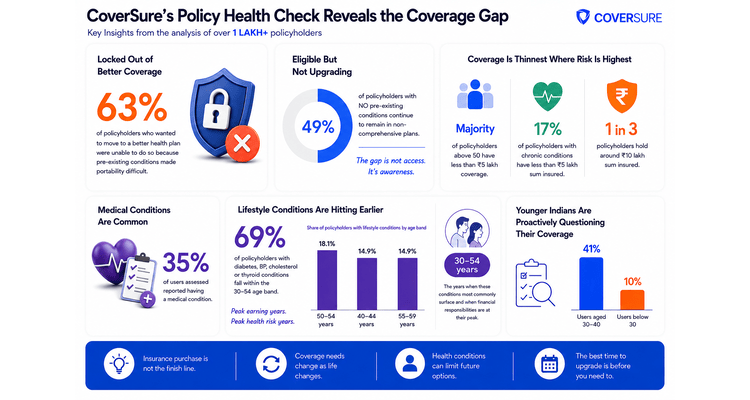
One finding sits at the older end of the insured population. A majority of policyholders above 50 years of age carry a sum insured below ₹5 lakh a figure that a single hospitalisation in a tier-1 city can wipe out. Among policyholders already living with chronic conditions, 17% hold less than ₹5 lakh in cover. These are exactly the people statistically most likely to need it.
For many, the problem isn’t a lack of intent. 63% of policyholders who wanted to switch to a more suitable health plan were unable to do so primarily because a pre-existing condition had, by the time they tried, already made migration or portability difficult.
The gap here is not one of access. It is one of awareness and engagement. Nearly 49% of existing policyholders with no pre-existing conditions people who are medically eligible and free to upgrade right now continue to hold basic, non-comprehensive plans. Many policyholders simply do not revisit their insurance after buying it, and so coverage that was adequate at one point in life quietly becomes inadequate as circumstances change.
The health data underlines why timing matters. Around 35% of those assessed reported a medical condition, and nearly 69% of lifestyle-related ailments diabetes, hypertension, high cholesterol, thyroid disorders — surfaced in the 30-54 age band, with the 50-54 group alone accounting for the single largest share at 18.1%. These conditions are arriving squarely during peak earning years, at the exact life stage when a coverage gap costs the most.
There’s a counter-signal worth watching too: 41% of users who ran a Policy Health Check were between 30 and 40, with another 10% under 30 a younger cohort choosing to check in on their coverage well before a medical event forces the question.
Commenting on the findings, Saurabh Vijayvergia, Founder & CEO, CoverSure, said, “Buying insurance is a starting point, not a destination. A policy that was right at 32 may leave someone dangerously underprotected at 35. Healthcare costs are rising, and lifestyle conditions are arriving earlier than most people expect. The problem is that policyholders rarely discover these gaps on their own; they discover them during a medical event, when it is already too late to change anything. The most dangerous period in insurance is not before you buy. It is the years after, when life has moved and the policy has not. The Policy Health Check exists to surface that gap before it becomes a crisis.”
CoverSure’s Policy Health Check evaluates a policyholder’s sum insured adequacy, plan comprehensiveness, pre-existing disease implications, and portability considerations giving policyholders a clear, single view of where they stand and what, if anything, needs to change.
Send news announcements/press releases to:
editor@thefoundermedia.com