
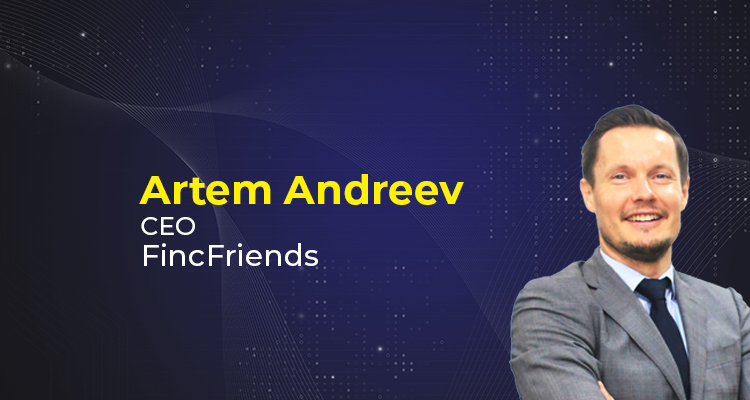
You’ve spent years building digital lending solutions for underserved customers. Looking back, what has been the single biggest opportunity that changed the trajectory of FincFriends, and how did you know it was the right bet?
The single biggest opportunity was India’s digital public infrastructure maturing at exactly the moment we needed it, above all, the Account Aggregator framework. Our customers are often creditworthy people who are simply invisible to traditional underwriting: salaried and self-employed Indians with real, regular income but thin or non-existent bureau files. For years, the industry’s answer was either to decline them or to price them punitively.
Consent-based access to verified bank data changed that equation. It let us underwrite actual cash flows, how money really moves through a person’s account, rather than relying on what a bureau file fails to say. Honestly, we did not know it was the right bet on day one. We ran cash-flow underwriting in parallel with our existing models and watched the vintages. When cohorts underwritten on verified financial data consistently outperformed, quarter after quarter, we stopped treating it as an experiment and rebuilt our credit process around it. That decision is what set FincFriends on the path from a small-ticket lender to a company building a genuine near-prime franchise.
Every fintech leader faces moments that don’t go as planned. Can you share a failure or decision you regret during your journey at FincFriends, and what lesson from that experience still influences your leadership today?
My honest regret is that we stayed too long with our original model, short-tenor, small-ticket loans, before seriously beginning the move up-market. The uncomfortable truth is that it worked commercially, and success is a poor teacher. Because the numbers were good, we postponed the harder transformation: better customers, larger tickets, longer relationships, lower pricing. Every quarter of delay made the eventual transition steeper.
Two lessons from that still shape how I lead. First, you must start building your next business model while the current one is still healthy; if you wait until the data forces you, you are already late. Second, treat regulation as product-design input, not as a compliance afterthought. The direction of regulatory travel in Indian lending has been consistent and, frankly, correct: more transparency, more borrower protection, more accountability. Today we deliberately invest in governance and controls ahead of what our current scale strictly requires, because we intend to be a much larger institution, and you cannot retrofit trust.
The digital lending industry has evolved rapidly with changing regulations and customer expectations. Was there a moment when you had to completely rethink your strategy? What triggered that shift, and what did it teach you about building a resilient business?
The RBI’s Digital Lending Guidelines in 2022 were that moment for the whole industry, including us. Direct fund flows between the regulated lender and the borrower, clearly defined roles for service providers, and standardized disclosure of the full cost of credit through the Key Fact Statement- together, these redrew the architecture of digital lending in India.
Some players experienced the guidelines as a constraint. We made a deliberate choice to experience them as a blueprint, and rebuilt our business squarely around the regulated balance sheet as the core of everything we do. It was not painless, but it left us with a cleaner, more resilient model, one that institutional counterparties can underwrite. Our investment-grade credit rating and the institutional funding relationships we have built since are direct consequences of that choice. The lesson: in lending, the regulator defines the playing field. A resilient business is aligned with where regulation is going, not arbitraging where it currently is. Rules-driven markets ultimately reward the companies that internalize the rules earliest.
FincFriends has focused on making credit more accessible while maintaining responsible lending. What’s been the toughest balance to strike between rapid growth and risk management, and how have you navigated that challenge?
The toughest balance is resisting the growth you could have. In digital lending, volume is always available; loosen approval criteria, and the book grows immediately, while the consequences arrive quarters later. The discipline is structural, not heroic. We manage the business on cohort-level unit economics and vintage performance, not on headline disbursement numbers. We invested heavily in repayment infrastructure, so that repaying us is the easiest financial obligation our customer has each month. And we hold a simple rule: we do not lend what the data does not support, however attractive the growth would look.
The evidence that the balance can be struck is in our results: in FY26 we grew AUM by 43% while remaining profitable, with zero accumulated losses. But the number I watch most closely is that 74% of our lending goes to repeat borrowers. Customers who come back, on transparent terms, are the real referendum on whether lending is responsible.
As you look toward the next five years, what are your biggest aspirations for FincFriends, and what milestones would define success for you as a leader?
Our next phase is about going deeper, not simply getting bigger. Concretely, that means completing our transformation into a near-prime lender: larger ticket sizes, longer tenors, and progressively lower pricing as our data advantage compounds. It means continuing to diversify our funding base on the strength of our credit rating, and building governance and risk management to the standard of a large, systemically trusted NBFC, ahead of the scale that demands it.
The milestone that matters most to me personally is customer graduation. We have served more than 5.5 million borrowers, many of whom entered the formal credit system through us. Success in five years looks like millions of those customers holding a materially better credit profile than when we first met them, borrowing more affordably, from us and from others, because their track record now speaks for them. If FincFriends becomes proof that profitability and responsible lending are not a trade-off in Indian credit, that is a legacy worth building.
Enjoyed this interview? Now imagine yours. Write to:
jeevika@thefoundermedia.in