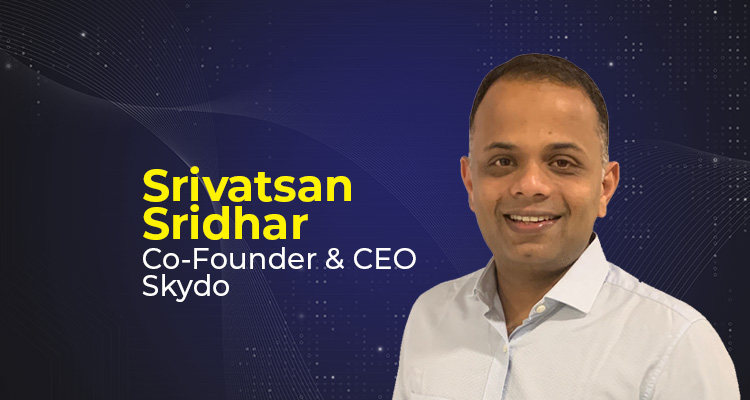
What were the biggest problems exporters faced with legacy systems earlier, and how is Skydo differentiating itself from its competitors?
The legacy experience was broken down into three predictable areas: cost, speed, and paperwork. First, exporters routinely lost margin to FX markups and unclear fees. You’d only discover the “real” cost after the money landed. Second, settlement timelines were uncertain, which hurt working capital. And third, compliance was manual and fragmented. Exporters had to run around for documentation, follow-ups, and reconciliations.
Skydo was built to make this predictable and clean. We give exporters local account details in key markets so clients can pay locally, we convert at live rates with transparent pricing, and we ensure settlements are fast and trackable. The other big differentiator is that we don’t treat compliance as an afterthought; it is thought of from the very beginning. For example, along with issuing free instant FIRA, we’ve automated EDPMS closure flows and enabled automated eBRC issuance for Amazon sellers, which removes a huge amount of operational load for businesses.
We’re also expanding corridors, including the UAE and parts of Africa, because exporters shouldn’t have to redesign their payment stack every time they enter a new market.
What regulatory grey areas still exist for cross-border FinTechs in India today?
The biggest shift in the last year is that cross-border payments are moving from “interpretation-led” to “framework-led.” That’s good for customers and for credible players.
That said, cross-border is inherently multi-jurisdictional, so some complexity will always exist at the edges. Areas like how different countries treat KYC/AML evidence, how quickly standards evolve for merchant monitoring, and how reporting expectations get operationalised across the ecosystem can still create friction.
What we’ve learned is: if you build for the strictest interpretation: strong controls, strong audits, clear segregation, clear reporting, the “grey” reduces over time. We’ve leaned into this approach and recently received full RBI authorisation as a PA-CB (Payment Aggregator – Cross Border). I see that as a net positive for the entire ecosystem because it raises trust and reduces ambiguity.
How do you balance compliance robustness with the need for frictionless user experience?
By treating compliance as a product problem, not a support problem. Most “friction” comes when compliance is handled manually: repeated document requests, back-and-forth with banks, unclear instructions, and delayed resolution. The goal isn’t to reduce compliance. The goal is to reduce avoidable friction through automation and clear workflows.
So we’ve invested in building guardrails into the system: structured onboarding, tighter transaction monitoring, clearer data capture at the right moment, and automated documentation. We prioritise building compliance in the very flow so that they feel guided at every step.
A simple example is export documentation. Instead of exporters chasing certificates and closures as a separate job, the platform should reconcile and generate what’s needed as part of the payment lifecycle. That’s the direction we’ve taken with automated FIRA and also automated eBRC for Amazon sellers.
Robust compliance and great UX are not opposites; they just require engineering effort.
How do you build trust with first-time exporters handling international payments for the first time?
First-time exporters don’t just want a payment product; they want certainty.
They’re worried about three things: “Will I get paid?”, “Will I lose money to hidden charges?”, and “Will I get stuck on compliance later?” Trust is built when your system answers those questions without drama.
For us, trust starts with being regulated and transparent. RBI authorisation matters because it signals that the platform is operating within a formal, monitored framework, not a loosely structured workaround.
Second, we obsess over visibility. If a user can track their payment, know the fees upfront, see the FX rate applied, and access their documentation in one place, their anxiety drops immediately. Uncertainty is what kills trust, not complexity.
Third, we support the “first export” moment heavily. The first international payment is usually the most stressful. If that experience is smooth, fast settlement, clear communication, and automated documentation, exporters become confident very quickly.
How do you expect cross-border payment costs to evolve as FinTech adoption increases?
I think we’ll see a steady compression in two layers of cost: transaction inefficiency and operational overhead.
Transaction inefficiency is what exporters face today through opaque markups and multiple intermediaries. FinTech adoption reduces that through better routing, cleaner pricing, and scale.
The second layer is underrated: operational overhead. The time spent reconciling payments, running after paperwork, closing shipping bills, and managing compliance follow-ups is a real cost, especially for SMEs. As platforms automate more of the compliance and reconciliation stack, the “all-in” cost of receiving money internationally drops even if the headline transfer fee looks similar.
Over time, basic cross-border payments will start looking like an infrastructure service: predictable, low-margin, and fast, and platforms will differentiate through depth: more corridors, better compliance automation, better working capital support, and end-to-end trade workflows.
That’s also our long-term direction: to become a one-stop platform for cross-border receiving export payments, enabling import payments, expanding corridors like the UAE and Africa, and making compliance simpler every year.
Enjoyed this interview? Now imagine yours. Write to:
editor@thefoundermedia.com