
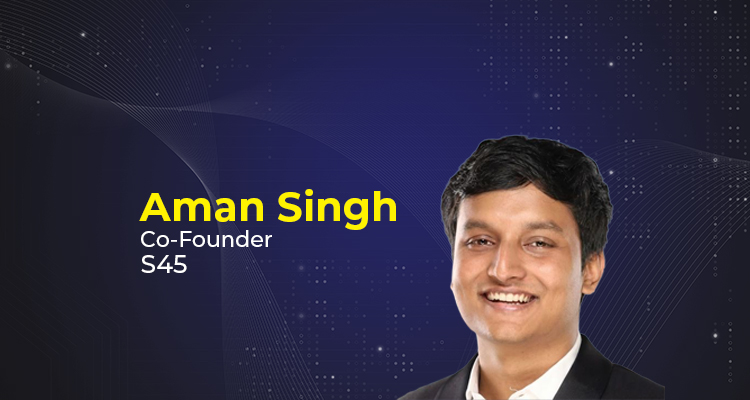
Having built SayF as a consumer-facing venture earlier, what shifted in your thinking that led you toward enterprise-grade financial infrastructure with S45?
SayF taught me a lot about building products and distribution. Over time, though, I became more interested in what happens when technology changes an industry’s operating model, rather than just its customer interface.
Financial services are interesting because historically, scale has largely meant scaling people. More clients and transactions meant more bankers, analysts, relationship managers and operating teams. Much of an institution’s intelligence sat with its people.
AI made us question whether that equation still needs to hold.
We started S45 with investment banking because it is a business where deep company understanding, judgment, relationships and execution all matter together. None of those exists in isolation. Great judgment usually comes from having done a lot of the underlying work.
The broader question for us is simple: if you were building a financial institution from scratch today, would you build it the same way the last generation was built?
We believe AI gives us an opportunity to rethink that model from the ground up.
How does S45 define the difference between an AI feature bolted onto a legacy investment banking process versus what the company calls being genuinely “AI-native”?
Putting a copilot in front of every banker does not make an institution AI-native. It can make the existing institution more productive, which is useful, but the underlying model remains largely unchanged.
For us, AI-native starts when the way the work itself is organised begins to change.
Instead of thinking about AI as something that helps a banker perform individual tasks faster, we think about how technology can participate across an entire transaction, from understanding information to doing analysis, coordinating work and helping people make better decisions.
Humans remain extremely important, but the role of the human should evolve as the system becomes more capable.
Ultimately, the test should show up in the economics. If doing more business materially always requires adding people in roughly the same proportion, then we have improved the traditional model rather than created a fundamentally different one.
What internal testing or validation process does S45 run before trusting a new AI model update to touch live client data during an active IPO process?
Our starting assumption is that a new model is untrusted until it proves itself on the specific work, we expect it to perform.
Generic benchmarks are useful, but they are not enough for a live financial transaction. We test models against actual workflows and failure modes: calculation errors, conflicting sources, missing information, unusual disclosures and cases where there may simply not be enough evidence to reach a conclusion.
We care a lot about whether the system can recognise uncertainty. In financial services, knowing when to stop and ask for review can be as important as producing the right answer.
We also separate what the system can prepare from what it is authorised to approve. Human review remains part of high-stakes workflows.
As reliability improves, those boundaries can evolve. But capability and authority are two different questions, and we treat them that way.
How does S45’s system reconcile a company’s financial data when it comes in inconsistent formats, like scattered Excel sheets or legacy ERP exports, before it can even begin readiness scanning?
The first step is separating what can be solved deterministically from what genuinely requires interpretation.
A lot of financial reconciliation is rules-based. You can standardise formats, map line items, align reporting periods, reconcile totals, identify duplicate or missing entries and check one source against another. We try to solve as much of that layer deterministically as possible because, particularly with financial data, you don’t want a model guessing where a rule can give you an exact answer.
The non-deterministic layer starts where the information itself requires interpretation. Two sources might use different definitions, an accounting treatment may have changed, or the reason behind a discrepancy may not be explicit.
That is where AI becomes useful for understanding the underlying context and surfacing what needs attention.
The principle is fairly straightforward: use deterministic systems wherever the answer can be known, and AI where the problem genuinely requires interpretation.
As S45 scales past its current sector coverage, what’s the biggest engineering constraint standing between the company and handling significantly higher deal volume simultaneously?
The biggest constraint is maintaining reliability as both deal volume and complexity increase.
Handling ten transactions is very different from handling hundreds across sectors, each with different data quality, timelines, edge cases and regulatory requirements.
The challenge is not simply getting models to do more work. It is making sure the overall system behaves predictably when many workflows are running at the same time.
That means strong orchestration, clear review and escalation paths, continuous evaluation and enough observability to know quickly when something is going wrong.
For us, scale is therefore not just a throughput problem. The real engineering test is whether we can increase the amount of work the institution can handle materially while maintaining the same standard of accuracy and control.
If we can do that, then the operating model starts to look very different from one where every increase in business requires a similar increase in people.