
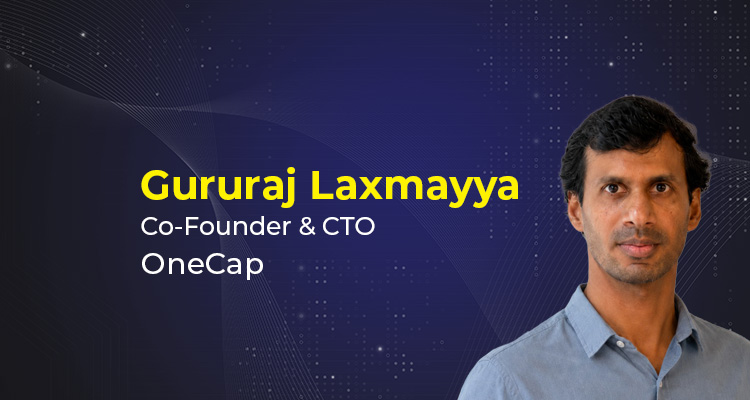
Every successful startup begins by solving a real problem. What inspired the creation of OneCap, and what gap in enterprise finance convinced you that reconciliation needed to be reimagined from the ground up?
My background is in building payment and settlement systems at scale, first at PayPal and later at Payzapp (Zeta). That experience taught me that moving money is only half the problem. The other half is proving that every rupee that moved is correctly reflected across systems that were never designed to agree with one another.
That is still the reality of enterprise finance. Banks, payment gateways, tax portals, and counterparty ledgers sit on one side; the company’s ERP and internal books sit on the other. Files, emails, and spreadsheets are often the only bridge. Over time, these gaps become audit risk, stale decisions, and financial leakage hidden inside unresolved mismatches.
What convinced us to build OneCap was a structural limitation in existing products. Most are rules engines supported by professional services. Every new bank format, gateway update, or counterparty ledger can trigger another mapping cycle. This makes the economics difficult for mid-market companies and leaves larger enterprises dependent on implementation teams. Rules can only match what someone anticipated. We believed reconciliation needed a system that could encounter an unfamiliar counterparty file, understand it, and still make progress. That unknown side, especially in ledger-to-counterparty reconciliation, is where OneCap began.
Many organizations have already invested in ERP systems and finance automation tools. Why did you choose to build an AI-native reconciliation platform instead of enhancing existing automation, and what differentiates OneCap from conventional solutions?
ERPs and traditional automation are good at recording and routing known structures. Reconciliation becomes difficult between systems: bank narrations, fee netting, dispute codes, different accounting conventions, and file formats that change without warning. Expanding a rules library helps, but every new shape of data still needs configuration.
We chose an AI-native architecture because reconciliation often involves incomplete or unfamiliar data. Rather than requiring every format and matching rule to be configured in advance, OneCap can interpret new data patterns and adapt the reconciliation process accordingly. It learns from reviewed outcomes and refers uncertain cases to finance teams for judgement. This allows the platform to handle greater complexity without turning every new format into another implementation project.
The difference is not simply that we use AI. The product is designed to reduce dependence on
professional services during onboarding and after go-live. New formats should be handled at runtime, not become fresh implementation projects. But AI capability alone is not an enterprise product. Controllers need explainable outcomes, preparer–reviewer workflows, audit trails, scheduled runs, and ERP write-back. Those less glamorous details make it trustworthy enough for the financial close.
Enterprise finance is increasingly being seen as one of the strongest use cases for AI. What makes financial reconciliation particularly suited for AI, and what challenges must organizations overcome to realize its full potential?
Reconciliation combines high transaction volumes, inconsistent data, and a surprising amount of judgement. Two entries may represent the same economic event while looking completely different. AI can identify patterns, propose matches, classify exceptions, explain discrepancies, and coordinate follow-ups- work that consumes analyst time without using their most valuable skills.
However, finance cannot operate on “mostly right”. Outcomes must be explainable, repeatable, and defensible during an audit. Organisations need clear data ownership, access controls, confidence thresholds, and human review for cases where judgement matters. They must also redesign the process itself. Adding copilots to an old close process may make individual steps faster, but it will not create end-to-end integrity. The real work is deciding what the agent owns, where people intervene, what should be measured, and how corrections feed back into the system.
Reconciliation is also the foundation for what comes next. If the books are late or incomplete, even a sophisticated forecast rests on weak data. Continuous, trusted reconciliation allows finance to move from explaining the past toward seeing what may happen next with greater confidence.
Winning the trust of enterprise customers is never easy, especially in finance. What were some of the biggest challenges you faced in acquiring your early customers, and how has customer feedback shaped the evolution of OneCap?
The hardest part was not demonstrating the product. It was asking finance leaders to trust a young company with the integrity of their books. Early in our journey, we confronted an uncomfortable truth: when a reconciliation went wrong, the customer would sometimes notice it first. In effect, the customer had become part of our monitoring system. That was not the relationship we wanted to build.
Customer feedback pushed us to reverse that process. We first built a reconciliation playground so customer success and engineering could investigate issues together. We then made the agent the first responder. It audits every reconciliation instead of waiting for a complaint, investigates anomalies, proposes fixes, and escalates cases requiring human judgement. Controllers and AP teams also made it clear that the product had to work for finance users, produce results they could sign off on, and fit their existing procedures.
That feedback shaped the product and our operating model. OneCap is now live with 12 mid-market and enterprise customers, including Malabar Gold & Diamonds, HomeLane, and CityMall. We have analysed approximately 17 lakh transactions worth Rs 18,290 crore, reconciled 850 counterparties, and surfaced around Rs 530 crore in discrepancies. More important is the changed relationship: customers no longer act as quality control. They review a system that has already completed the first investigation.
Looking ahead, how do you envision the future of enterprise finance as AI becomes more autonomous? What role will finance teams, CFOs, and intelligent AI agents play in shaping the next generation of financial operations?
I see finance moving from human-operated processes supported by AI assistants toward agent-operated processes supervised by people. Agents will handle routine matching, chase open items, prepare balance confirmations, investigate common exceptions, and keep the books closer to a continuously reconciled state. Finance teams will spend more time on judgement, controls, policy, and advising the business.
For CFOs, the opportunity is not another dashboard. It is a stronger financial integrity layer that supports continuous awareness and better foresight. Autonomous finance should not be unsupervised: someone must own the system, answer for its decisions, and improve it. AI copilots were the starting point. The next step is routine finance that largely runs itself, with people focused on the judgement that moves the business.
Enjoyed this interview? Now imagine yours. Write to:
jeevika@thefoundermedia.in