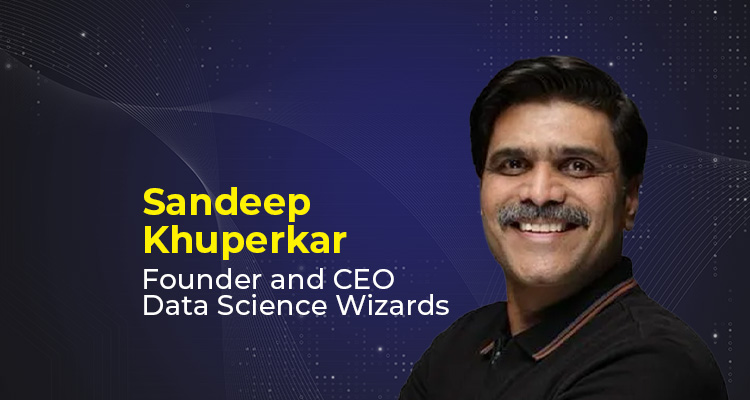
What is the founding vision behind Data Science Wizards, and how does it differentiate itself from other AI platform providers?
The founding vision of Data Science Wizards (DSW) has been to make AI adoption real, scalable, and responsible for enterprises. Over the years, AI deployments often stalled in ‘pilot mode,’ not because of lack of technology, but because enterprises lacked an infrastructure layer to embed AI into the core of their operations.
DSW’s UnifyAI was built to address this gap. It is not another AI tool; it is the OS for Enterprise AI — a platform that unifies the lifecycle of data, models, agents, governance, and deployment. This allows enterprises to move from isolated experiments to production-grade AI systems at speed and with confidence.
What differentiates us is:
- A unified lifecycle that connects data to deployment seamlessly.
- Enterprise-grade governance, ensuring AI is usable even in highly regulated industries.
- Deployment flexibility without lock-in, across on-premises, hybrid, or cloud environments.
In essence, UnifyAI helps enterprises treat AI not as an add-on, but as a foundational business capability.
How does UnifyAI handle hybrid AI execution across cloud and on-premise environments?
Hybrid execution is a foundational principle of UnifyAI’s architecture. In BFSI and other regulated industries, critical workloads cannot reside fully on public cloud due to compliance, data residency, and security requirements. At the same time, enterprises need the elasticity of cloud to scale compute-heavy workloads such as model training or GenAI use cases.
UnifyAI addresses this by being infrastructure-agnostic. It enables enterprises to deploy and run AI seamlessly across on-premises, private cloud, and public cloud environments without changing the way teams build or govern their models.
Key to this is a centralised control plane that provides governance, observability, and policy enforcement across all environments. Every model, workflow, and decision is traceable and explainable, ensuring enterprises can scale AI adoption responsibly while meeting regulatory expectations.
With this approach, organisations can keep sensitive workloads in-house, leverage cloud where scale is required, and operate with full flexibility — all without vendor lock-in.
What impact has insurAInce had on reducing claims fraud and improving persistency prediction in live deployments?
insurAInce, built on UnifyAI, is our flagship vertical solution for insurers. It addresses two of the most critical business priorities in the industry:
Claims fraud detection: By combining GenAI-driven document parsing with anomaly detection, insurAInce enables insurers to identify fraudulent claims earlier and handle them at scale with greater efficiency. This not only reduces financial leakage but also accelerates claims resolution, strengthening customer trust.
Persistency prediction: Predictive models that leverage both structured policyholder data and unstructured sources like call transcripts generate early warning signals for lapses. This allows insurers to engage proactively with customers, improving retention and protecting long-term profitability.
What makes insurAInce impactful is not just the sophistication of its models, but the governance and explainability embedded in every workflow. With UnifyAI as the backbone, insurers gain a system that scales predictably, learns continuously from ground-level feedback, and delivers insights they can trust in highly regulated environments.
For BFSI clients, how does your platform improve fraud detection accuracy while keeping false positives low?
Fraud detection is only valuable if accuracy is achieved without overburdening teams with false positives. UnifyAI improves this balance through a multi-layered strategy:
- Hybrid data models capture richer fraud signals by blending structured transactions with unstructured content like chats and documents.
- Adaptive feedback loops refine models continuously using investigator inputs, improving accuracy over time.
- Confidence scoring APIs quantify the reliability of predictions, enabling risk-based prioritization.
- Agentic AI orchestration manages entire fraud investigation workflows, surfacing only cases requiring human judgment.
The result: BFSI clients achieve higher fraud detection rates while maintaining false positives, ensuring both compliance and customer trust.
What safeguards are in place to ensure explainability, transparency, and traceability in GenAI-powered workflows?
Trust is fundamental to AI adoption, and UnifyAI addresses this through a governed GenAI framework that incorporates safeguards at every level. The platform features a Prompt Hub with versioning, ensuring that every prompt, model, and output remains fully auditable. Guardrails and policy enforcement are built into workflows to embed both regulatory and business rules seamlessly.
Additionally, explainability layers provide context and rationale for outputs, making AI decisions interpretable for users. Complementing this, traceability logs capture the complete decision journey, creating an end-to-end audit trail.
Together, these measures ensure that GenAI in BFSI and other highly regulated industries does not operate as a ‘black box,’ but rather as a transparent, controlled system that enterprises can adopt with confidence.
How do you see the role of AI in reshaping risk management and fraud detection in the next 5 years?
The next five years will bring a fundamental transformation in the way risk and fraud are managed, with humans remaining an essential part of the loop. Three key trends are expected to shape this evolution:
- Agentic AI systems will autonomously manage end-to-end workflows, from detection to resolution, thereby reducing dependence on manual intervention while ensuring human oversight remains integral.
- Real-time risk engines will emerge, powered by AI-native infrastructure, enabling dynamic risk scoring across portfolios and transactions with unprecedented speed and accuracy.
- Collaborative ecosystems will take shape, where banks, insurers, and regulators securely share AI-driven insights. This will strengthen fraud prevention efforts while safeguarding privacy and compliance.
Overall, risk management will shift from a reactive model to a proactive and predictive one. The enterprises that succeed will be those that embed AI as a core infrastructure layer rather than treating it as a siloed tool while maintaining a balance between automation and human judgment.
Enjoyed this interview? Now imagine yours. Write to:
editor@thefoundermedia.com