
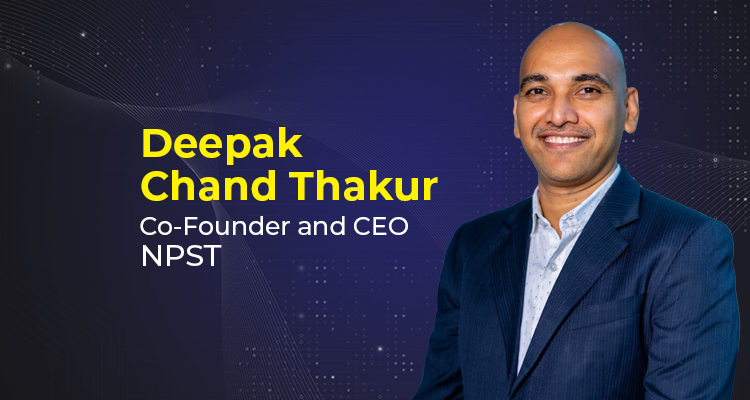
NPST operates across three distinct verticals: Technology Service Provider (TSP), Platform-as-a-Service (PPaaS), and consumer-facing products. How does the company ensure these verticals reinforce one another rather than dilute focus?
That is a deliberate design choice. We do not look at these as three separate businesses. We see them as three layers of the same technology ecosystem.
Our TSP business provides the core payment infrastructure, including UPI, Banking Connect, Bharat Connect, CBDC and IMPS. PPaaS builds on that foundation by enabling banks to launch merchant acquiring, QR acceptance, and other payment services without having to build the underlying infrastructure themselves. The digital engagement layer then helps banks extend those capabilities to their customers.
The important point is that they all sit on a common technology architecture, with shared APIs, security, data models and operational intelligence. For a bank, that means working with a single technology partner rather than managing multiple vendors solving adjacent problems.
The Bank-in-a-Box platform covers UPI, IMPS, Banking Connect, merchant acceptance, AI-driven fraud monitoring, and a SuperApp with over 400 banking services. How does NPST tailor such a comprehensive stack to the varied needs of cooperative and smaller banks?
Every bank is on a different digital journey, so flexibility is important. A cooperative bank will naturally have different priorities from a scheduled commercial bank, and the technology has to reflect that.
That is why Bank-in-a-Box is modular and cloud native. Banks can deploy payment switching, mobile banking, merchant acquiring, fraud management or digital engagement independently, or adopt the full platform without capex investment. Its API-first architecture integrates with existing core banking systems, allowing modernisation to happen in phases rather than through a large-scale replacement programme.
For smaller banks, this changes the economics of technology adoption. They gain access to enterprise-grade payment infrastructure without the implementation complexity, long timelines or multiple platform investments that have traditionally acted as barriers.
The platform also evolves alongside RBI and NPCI guidelines, reducing the operational burden on banks as regulatory requirements change. Our objective is straightforward. Access to modern payment technology should not depend on the size of a bank.
As NPST embeds AI across payment processing, fraud prevention, and compliance, how does the company ensure these AI systems remain explainable, auditable, and aligned with RBI’s regulatory expectations?
The regulatory conversation around AI has changed. Until recently, the focus was largely on what AI could automate or optimise. RBI has now made it equally important to demonstrate how AI models are governed, validated and monitored throughout their lifecycle. For financial institutions, model accuracy alone is no longer enough. They need to understand why a model reached a particular decision, maintain a clear audit trail, enable human oversight where required, and demonstrate that to regulators.
That philosophy is reflected in our Risk Intelligence Decisioning Platform (RIDP). RIDP is designed to help banks risk-based decisions across merchant onboarding, transaction monitoring and fraud management. It combines AI models with configurable business rules, risk scoring and policy-driven decision engines, enabling institutions to detect suspicious activity while ensuring every decision remains transparent and explainable. Banks can understand why a transaction or merchant has been flagged, while retaining full control over approval thresholds, escalation workflows and policy parameters. The AI operates within the bank’s governance framework rather than independently of it.
The company re-architected Evok 4.0 for global MDR and interchange-based markets, which differ structurally from India’s zero-MDR UPI model. How is NPST adapting its product economics for these markets?
Payment markets are fundamentally local. While the underlying technology may be similar, the commercial models, regulatory frameworks and customer expectations differ from one market to another. A product built for India’s zero-MDR environment cannot simply be exported without adaptation.
That is one of the reasons we re-architected Evok 4.0 as a configurable Payments Platform-as-a-Service rather than a market-specific acquiring platform. The core architecture remains the same, but commercial models, pricing logic, settlement workflows, interchange structures and regulatory requirements can be configured to suit individual markets. This allows financial institutions to launch acquiring services without rebuilding the platform for each geography.
Our approach is to provide the technology layer while enabling banks and payment providers to operate within their local commercial and regulatory environment. Whether the market follows an MDR, interchange or hybrid model, the platform is designed to support those economics without changing the underlying infrastructure.
As we expand internationally, our objective is not to replicate India’s payments ecosystem. It is to apply the capabilities we have built at scale in India in a way that aligns with the realities of each market. We believe that balance between standardised technology and local adaptability will be important for sustainable growth.
Looking ahead to FY27 and beyond, what does NPST consider the single most important shift in the BFSI and payments landscape, and how is the company positioning itself to capitalise on it?
Payments are increasingly becoming part of financial infrastructure rather than remaining a standalone transaction service.
Transaction volumes will continue to grow, but the larger opportunity lies in the services built around those transactions. Embedded finance, merchant orchestration, risk management, compliance automation and cross-border payment capabilities will become increasingly important. At the same time, banks are expected to modernise legacy technology while maintaining resilience, security and regulatory compliance. Balancing those priorities will define the next phase of the industry.
Our strategy reflects that direction. We continue to invest across payment infrastructure, and RegTech while also expanding our international presence. India’s payments ecosystem has developed capabilities over the past decade that are increasingly relevant to financial institutions in other markets.
Over the long term, the differentiator will not simply be processing more transactions. It will be helping financial institutions modernise in a way that strengthens resilience, governance and customer experience together.
Enjoyed this interview? Now imagine yours. Write to:
editor@thefoundermedia.com