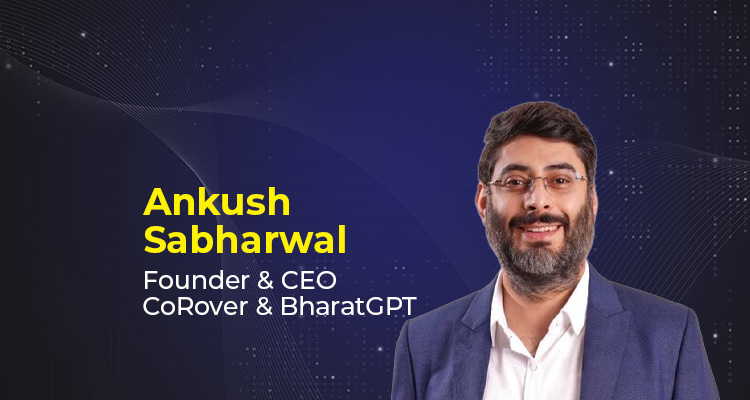
The payments landscape in India has always been dynamic, but with UPI 3.0 it is undergoing a paradigm shift where AI, voice, conversational UX, and inclusion intersect to reshape how millions transact daily. CoRover, in collaboration with NPCI and IRCTC, is proud to be part of this transformation.
Sharing his perspective on how AI-powered payments are shaping the UPI 3.0 ecosystem, Ankush highlighted the technical foundations, their impact, and the road ahead—particularly as voice-based payments in multiple languages are enabled across voice calls, mobile apps, feature phones, and web platforms
UPI 3.0: The next frontier
Since its launch in 2016, the Unified Payments Interface (UPI) has been continuously evolving. UPI 123Pay, AutoPay, RuPay credit linkage, UPI Lite, UPI Circle, Conversational AI Payments and so on, reflect incremental enhancements. UPI 3.0, however, aims at more fundamental shifts not just making payments more features-rich, but more human, intuitive and accessible. One of these shifts is conversational voice payments, which turn transaction flows into dialogue rather than forms.
Conversational Voice Payments: What, How, Why
In August 2024, CoRover, NPCI and IRCTC unveiled “Conversational Voice Payments” at the Global Fintech Fest, a breakthrough feature that enables users to complete UPI transactions either through voice commands or by typing their UPI ID or mobile number. Users can simply speak in their preferred language, such as Hindi, English, Gujarati and more, via a voice interface available on phone, app or web, with the AI system powered by CoRover’s BharatGPT processing the voice input seamlessly. If a mobile number is provided, the system automatically fetches the corresponding UPI ID and, through payment gateway APIs, initiates a UPI payment request via the user’s default UPI app. The solution also offers flexibility, allowing users to update their mobile number or UPI ID within a prescribed transaction time limit to rectify errors or make adjustments as needed. Integrated with AskDISHA, IRCTC’s AI virtual assistant, this innovation transforms everyday interactions such as “Book me a train ticket” or “I want to pay for my ticket” into simple voice driven commands making voice the new user interface.
Multilingual, Multidevice: Inclusivity by design
A core pillar of this initiative is inclusion. India is extremely diverse linguistically: hundreds of languages, dialectal variations, uneven digital literacy. To truly democratize payments, we need systems that respect that diversity. Conversational voice payments support multiple Indian languages (not just English or Hindi) and various input modes not just smartphones but feature phones, voice calls, and potentially web interfaces as well.
NPCI’s “Hello UPI” product overview outlines that Hello UPI will be enabled over telecom calls, UPI apps, and IoT devices. This means users on feature phones without full graphical UIs can still make UPI payments via voice or via DTMF or voice prompts. So, our goal is not just convenience for tech-savvy users, but true accessibility.
Technical challenges & safeguards
Bringing this vision alive requires solving some non-trivial challenges:
- Voice recognition and natural language understanding (NLU) across many languages and dialects. Accents, background noise, and ambient conditions matter. BharatGPT has been built and trained to recognise and interpret voice commands accurately in Hindi, Gujarati and more.
- Security and authentication: UPI demands robust verification (PIN, two-factor, etc.). Even when voice is used, the final confirmation (e.g. UPI PIN or another secure flow) must remain. The voice system must not bypass security; rather, it should integrate with existing secure protocols. From our launch, the system retrieves UPI ID but still requires confirmation via the UPI app.
- APIs and system integration: The voice-based system requires tight coupling with payment gateway APIs, NPCI’s backend, default UPI apps, and also front ends like AskDISHA. Handling API failures, latency, fallback flows (e.g. typing instead of speaking) is critical. From the launch, the system retrieves the UPI ID when given a mobile number and triggers a payment request via the existing UPI app that keeps compatibility high.
- Regulatory compliance and fraud prevention: Identity verification, audit trails, logging, dispute resolution must all comply with RBI / NPCI norms. AI components must be safe, explainable to some extent, robust to adversarial inputs.
Impact: What these changes mean in numbers
While conversational voice payments are recent, the data around UPI’s growth provides context for the scale of opportunity. UPI transaction volumes have grown exponentially over the years and, as of 2025, there are hundreds of millions of users, with UPI handling trillions of rupees worth of transactions monthly (specific recent numbers are proprietary to NPCI), which can be checked in the NPCI’s website.
Feature phone users, estimated around 400 million, represent a population segment that was underserved by app-based payments, and voice-based payments are now bringing them into the fold. Multilingual adoption supporting Hindi, Marathi, Gujarati, and other Indian languages further increase reach across Tier 2 and Tier 3/4 cities, where local languages dominate. Early feedback from pilot deployments indicates higher success and satisfaction rates when users can speak in their own language; in fact, at CoRover, internal metrics show error rates drop substantially when the voice interface matches the user’s preferred language, compared to forcing English or typed input. For IRCTC, the integration with AskDISHA means that millions of railway booking transactions may now be voice initiated. Considering that IRCTC handles tens of millions of bookings annually, even a small shift of users toward voice transactions can significantly reduce friction, improve booking rates, lower drop-offs, and increase revenue, particularly in less connected areas.
Why AI-powered payments are key to UPI 3.0’s success
- Accessibility: Voice opens up for those with low literacy, visual impairment, or even just discomfort with typing or reading long UPI IDs or digital forms.
- Speed & Convenience: Talking is faster than typing, especially on small keyboards or in mobile apps. For many micro-transactions, the friction of typing deters usage; voice removes that.
- Human-Centric UX: Conversational flows (voice + natural language prompts) make interaction more intuitive. This matters especially as banking/fintech touches everyday life travel bookings, bill payments, groceries, etc.
- Scale & Inclusivity: India’s UPI ecosystem has to keep scaling, but scaling must correspond with inclusion. Voice payments allow feature phone users, regional language speakers, and rural users to join the formal digital payments economy.
- Economics: Lower support costs, fewer help desk calls, fewer failed transactions, higher conversion all of which improve bottom lines for banks, payment gateways, merchants.
Looking ahead: What’s next for UPI + Voice + AI
As we move forward into UPI 3.0, there are a few trajectories that will shape how this landscape evolves. One of the most critical will be expanded language support, with the addition of many more Indian languages and dialects, including regional ones, while simultaneously improving dialect robust speech recognition. Another important direction is web and IoT integration, where voice payments will no longer be limited to apps and calls but will also extend to web platforms, smart devices, kiosks, and even voice activated payments on supported devices like smart speakers and wearables. For feature phones or low connectivity zones, offline voice based flows will be essential, leveraging a combination of voice, DTMF and IVR (Telephony AI) hybrids that require minimal or no internet. In parallel, contextual experiences will evolve, enabling users to initiate entire flows through simple commands for example, saying “I want to pay rent” or “I want two return tickets to Delhi,” after which the system carries the context, books, populates, and confirms seamlessly. We will soon have personalised and proactive payments suggestions/ reminders, like, do you want to pay for your broadband now, you may get a 10% discount if you pay today. Enhanced Conversational analytics for the banks; app providers and the users. At the same time, ensuring a better UX fallback will be key: when voice inputs fail due to noise, accent, or technical glitches, users should be able to fall back to typing or manual confirmation with minimal friction. Finally, as AI gets more deeply embedded into the payments ecosystem, privacy, explainability, and regulation will take center stage, with increasing demands for transparency, user consent, data protection, and auditing all of which must be integral to every design.
Conclusion
India’s UPI journey from its modest beginnings to a trillions rupee ecosystem has always been about inclusion, innovation, interoperability. AI-powered payments, particularly conversational voice systems, are not just another feature. They represent a fundamental shift toward making payments more human and more accessible. For CoRover.ai, this is not a technological fantasy but a tangible reality: voice payments in many Indian languages, executing via UPI flows, across phones, feature phones, web, all with security, speed, and delight.
As UPI 3.0 rolls out, we are entering an era where “speak, don’t type” becomes more than a slogan, it becomes standard. And that changes everything. Speaking is natural!
Send your exclusive thoughts to:
editor@thefoundermedia.com